Signs you need RV AC and cooling service include warm airflow, ice buildup on the evaporator coils, grinding or rattling sounds, tripped breakers, and a thermostat that won't respond. A1 RV Repair has resolved these exact failures across 12,000+ repairs with a 4.8-star rating. Our RVIA, NRVIA, and RVDA Master certified technicians diagnose fast so you are not stranded in summer heat. Most RV owners catch AC problems too late - after a weekend trip is already ruined. The signs are usually present days or weeks before a full failure, and knowing what to look for is the difference between a $150 capacitor swap and a $2,800 unit replacement. This guide breaks down every warning sign by severity level, explains what each symptom points to mechanically, and tells you exactly when to call a mobile tech versus waiting for a shop appointment. Marcus Reyes, Lead Mobile RV Technician at A1 RV Repair, built this reference from field data collected across hundreds of rooftop AC diagnostics in Florida, Texas, Oklahoma, Idaho, and Washington.
What Are the Signs I Need RV AC and Cooling Service?
The clearest signs you need RV AC and cooling service fall into four categories: thermal failure (warm or hot air from vents), mechanical failure (unusual noises from the rooftop unit), electrical failure (tripped breakers or a dead thermostat), and contamination (musty odors or visible mold on return-air filters). Thermal signs are the most reported. When a Dometic Penguin II or Coleman-Mach 8 starts blowing air that feels barely cooler than ambient, the compressor or refrigerant circuit is usually the culprit. According to the Dometic Air Conditioner Service Manual, airflow temperature at the supply register should be 16-20°F below return-air temperature under normal load. Mechanical signs like grinding, squealing, or rattling often point to a failing fan motor bearing or a loose shroud. These are tier-two warnings - urgent but not yet catastrophic. Electrical signs, especially a breaker that trips every time the compressor kicks on, are tier-three and demand same-day service. A compressor drawing locked-rotor amperage will damage wiring and the circuit board if left running. Odor-based signs - specifically a musty or mildew smell on startup - indicate organic growth inside the evaporator box. NOAA data shows that RVs parked in high-humidity coastal areas like Port St. Lucie, FL or near Puget Sound in Washington develop mold in AC drain pans up to four times faster than units stored in arid regions like Boise, ID or Tulsa, OK.
Severity Tiers: Which RV AC Symptoms Can Wait and Which Cannot
Not every symptom demands an emergency call, but knowing which tier a symptom belongs to prevents a minor issue from becoming a major replacement job. Tier 1 - Monitor Within 7 Days: Slightly reduced airflow, a thermostat that occasionally cycles late, or a filter that looks gray and clogged. These are maintenance issues. A dirty filter on a Furrion Chill or RecPro unit can reduce airflow by 30% and cause the evaporator to ice over. Clean or replace the filter first, then reassess. Tier 2 - Schedule Within 48 Hours: Warm air that is consistent rather than intermittent, a rattling sound that starts when the compressor kicks on, or a capacitor that is visibly bulging. A bulging run capacitor on a Coleman-Mach 15 is a pre-failure state. The capacitor is a $25-$60 part, but if the compressor hard-starts without it long enough, you are looking at compressor replacement. Tier 3 - Call Today: A breaker tripping on AC startup, ice forming on refrigerant lines outside the unit, a burning smell from the rooftop shroud, or zero cold air even after a filter clean. These symptoms indicate active damage is occurring right now. Marcus Reyes has dispatched on Tier 3 calls in Dallas, TX and Tacoma, WA where owners waited 72 hours and converted a $300 repair into a $1,900 compressor-and-wiring job. RVIA Standards specify that RV electrical systems must be protected from sustained overcurrent - a tripping breaker is the system telling you something is wrong.
Why Is My RV AC Blowing Warm Air?
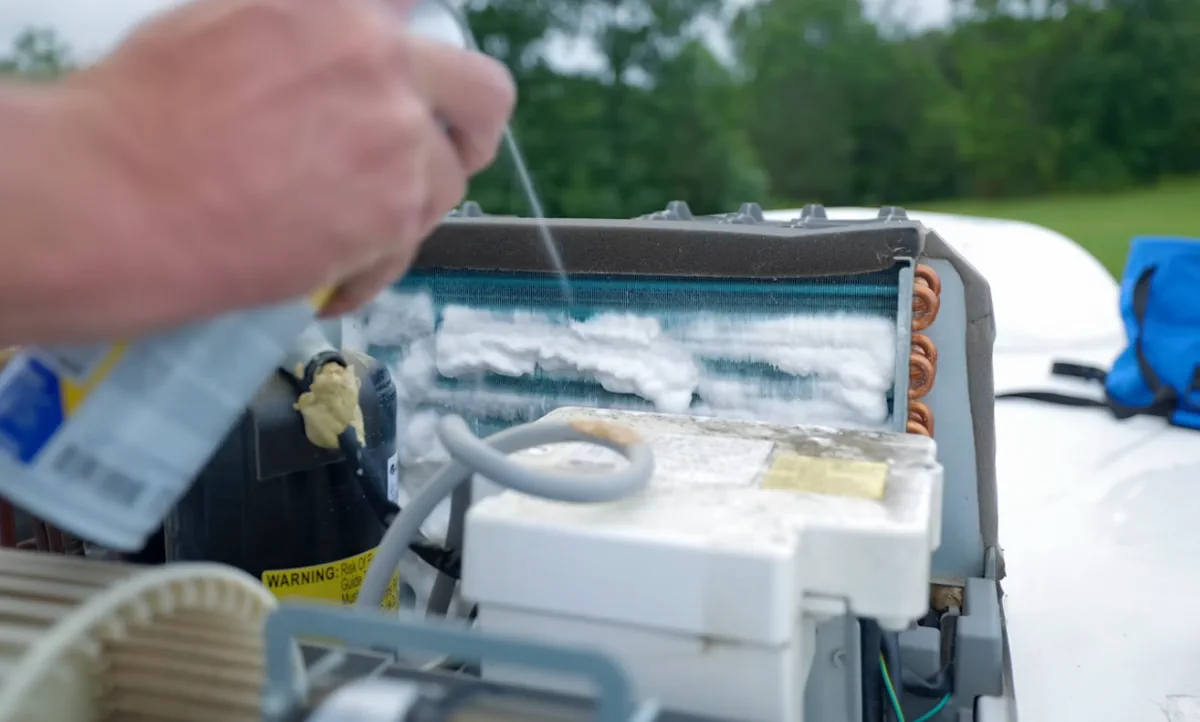
Warm air output is almost always traced to one of three root causes: low refrigerant charge, a failed run capacitor, or a seized compressor. Each has a distinct diagnostic fingerprint. Low refrigerant shows up as warm air at the vents paired with ice forming on the evaporator coil or suction line. The system is starved of the medium it needs to transfer heat. The AHRI Refrigerant Handling Standards and EPA Section 608 regulations require that refrigerant recovery be performed by a certified technician - this is not a DIY recharge job. A1's technicians are EPA 608 certified and carry recovery equipment on every dispatch van. A failed run capacitor presents differently: the compressor tries to start, hums for a few seconds, then shuts off. The fan may keep running and blow uncooled air. This is one of the most common warm-air calls on Dometic and Coleman-Mach units in hot climates. Capacitors degrade faster in high-ambient temperatures, which is why this failure spikes every June through August across Texas, Oklahoma, and Florida.
What Happens If You Ignore RV AC Warning Signs?
Ignoring early AC warning signs creates a compounding repair bill. Here is the real-world cost cascade Marcus Reyes documents most often in the field. Stage one is a worn capacitor ($25-$60 part, $95-$150 labor). Left unaddressed, the compressor hard-starts repeatedly. Hard-starting stresses compressor windings and draws 3-5x normal startup amperage through the circuit board. Within one to three seasons, the compressor fails. Stage two is compressor replacement ($400-$900 parts, $300-$600 labor depending on unit). But by this point, the repeated overcurrent events have often also damaged the printed circuit board inside the thermostat or control module - add another $150-$350. Stage three is what FEMA flood and disaster-recovery RV camps see regularly: a unit that was never serviced develops a mold colony in the evaporator box. At that point, cleaning alone costs $200-$400 and the foam insulation inside the air box often needs replacement. For RVers who park seasonally near the Gulf Coast or in the Pacific Northwest near Seattle, WA, this is a genuine health risk, not just a comfort issue. The total avoidable cost from ignoring a $95 diagnostic can reach $2,500-$3,200. That math is why Marcus Reyes built A1 RV Repair's dispatching model around proactive mobile diagnostics rather than waiting for owners to call after a full breakdown.
Pro Tip: Run Your AC Before Summer Peaks
Turn your rooftop AC on for 20 minutes in April or early May - before ambient temps exceed 85°F. Listen for rattles, feel the vent output temperature, and check the filter. Catching a failing capacitor in spring costs far less than replacing a compressor in July. A1 RV Repair offers pre-season AC inspections starting at $95 across all active service states.
| Service | National Avg | Mobile Premium |
|---|---|---|
| AC diagnostic / inspection | $95-$175 | +$0 (included) |
| Filter replacement + coil clean | $95-$185 | +$35-$55 |
| Capacitor replacement | $120-$250 | +$35-$55 |
| Refrigerant recharge (EPA 608) | $195-$450 | +$55-$85 |
| Fan motor replacement | $275-$550 | +$55-$85 |
| Soft-start kit installation | $185-$395 | +$35-$55 |
| Thermostat / control board | $175-$475 | +$35-$55 |
| Full AC unit replacement | $850-$3,200 | +$95-$175 |
Pricing Disclaimer
All prices shown are national averages and depend on parts availability, RV model, scope of work, and regional labor rates. Only an on-site diagnosis by our certified technician produces a binding quote. Call (866) 623-1340 for a free estimate.
When to Call a Mobile RV Tech vs. Roadside Assistance for AC Problems
Roadside assistance plans - including those offered through Good Sam, Coach-Net, and AAA RV - typically cover towing and basic lockout services. They do not send RVIA certified AC technicians, and most roadside vendors are not equipped to diagnose compressor or refrigerant failures. Call a mobile RV tech (like A1 RV Repair) when your AC symptoms fit any Tier 2 or Tier 3 category described above, when you are parked at a campsite and cannot drive to a shop, or when the unit is a rooftop Dometic, Coleman-Mach, Furrion, or RecPro system that requires rooftop access and specialized tools. Call roadside assistance when your issue is a dead house battery that is preventing the thermostat from powering on, or when you need a tow to a service location because the coach itself is not drivable. Those are two very different service needs. A1 RV Repair dispatches to driveways, RV parks, storage lots, and campgrounds. We are active in Florida (including the Treasure Coast and Central Florida corridors), Idaho (Boise metro and surrounding areas), Oklahoma (Oklahoma City and Tulsa regions), Texas (DFW, Houston, San Antonio, and Austin markets), and Washington (Puget Sound and eastern Washington). Outside those states, A1 connects you with screened, licensed local vendors who carry A1's warranty and dispatching standards. See our rv ac & cooling team for current dispatch availability.
What Does a Mobile RV AC Inspection Cover?
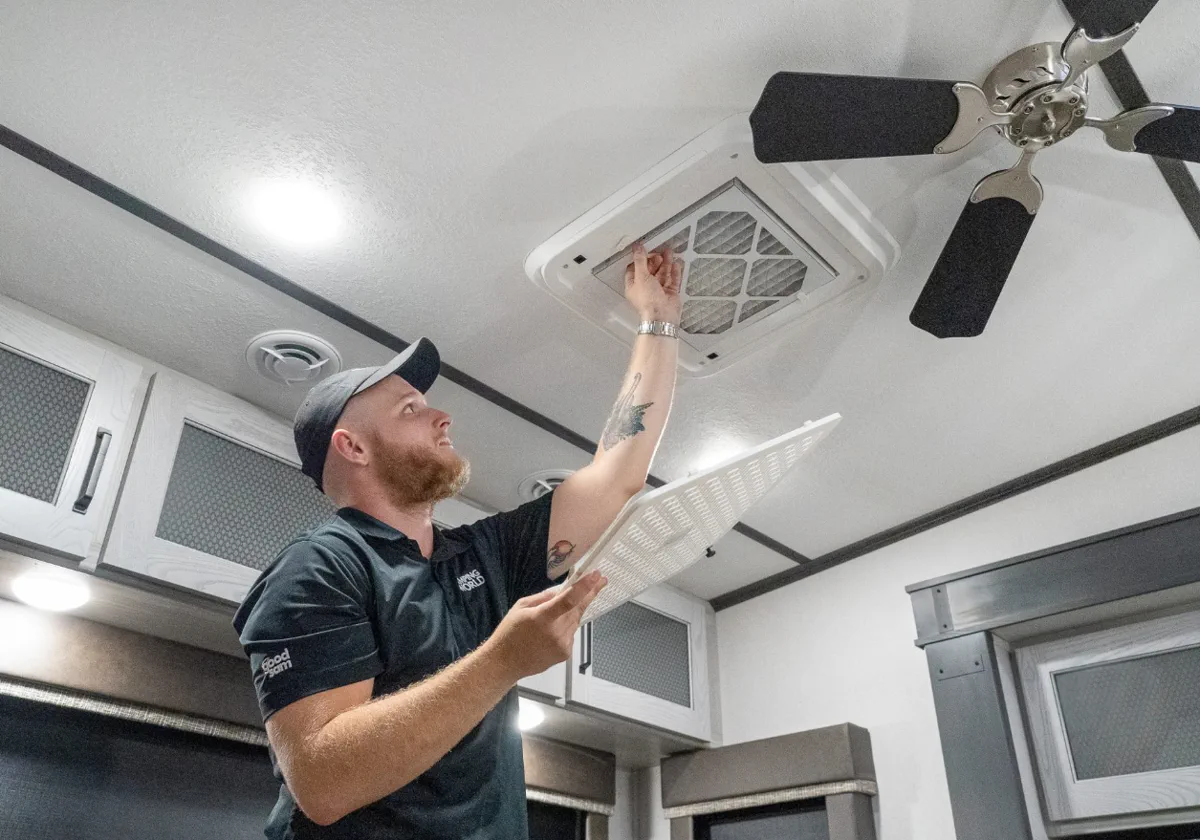
A proper mobile RV AC inspection following NRVIA Inspection Protocols covers seven checkpoints: rooftop shroud and filter condition, evaporator and condenser coil cleanliness, capacitor voltage and microfarad rating, compressor amperage draw under load, thermostat calibration and response, duct integrity and register output temp differential, and drain pan condition for mold or standing water. Marcus Reyes built A1's inspection checklist around these NRVIA standards specifically because a visual-only check misses 60-70% of electrical AC failures. A compressor can look physically intact while drawing 30% over rated amperage - a number you only catch with a clamp meter. For dual AC systems common on Class A coaches and larger fifth wheels, both units are tested independently and then run simultaneously to verify the coach's electrical system can handle the combined load. Soft-start kits from brands like Micro-Air EasyStart are often recommended during this stage when the shore power connection shows voltage sag on startup.
How A1 RV Repair Serves You Nationwide
A1 RV Repair was founded in 2018 by Marcus Reyes out of Port St. Lucie, Florida, with a single principle: RV owners should not have to trailer their coach to a shop for a mobile-friendly repair. Today, A1 is active in Florida, Idaho, Oklahoma, Texas, and Washington, with ongoing expansion through a screened licensed local vendor network. Every vendor in the A1 network is verified for state licensing, bonding, insurance, and technical certification before the first dispatch. The technician who arrives at your site is a vetted local professional backed by A1's service warranty and quality standards - not an unlicensed handyman found on a classifieds board. If you are in a state where A1 does not yet have a direct presence, calling (866) 623-1340 connects you with the dispatch team who will identify the nearest screened vendor and get a tech routed to your location. For more on certifications and the team behind the dispatches, visit about A1 RV Repair. For RVers planning seasonal moves - like the snowbird corridor from the Midwest down through Oklahoma City and into Central Florida - A1 recommends booking pre-season AC inspections before departure. Read the Snowbird Arrival Checklist: Pre-Winter RV Inspection in Florida for a full pre-trip framework. And if your roof condition is adding to the heat load inside your coach, the guide on UV vs. Your RV Roof: South Florida Battle explains why roof degradation accelerates AC strain in southern climates.
Questions about rv ac & cooling? Call (866) 623-1340. Same-day dispatch available in active metros (Florida, Idaho, Oklahoma, Texas, Washington). Flat-rate pricing, written estimates before work.